Anyone who had an office job in the nineties has cleared a minefield when they should have been working. A grey box on the screen, a grid of blank squares, a counter and a clock. You click, you count, and you try not to go bang.
My brief for this one-shot was to take that game somewhere new. The surprise had to land within a couple of clicks. I also asked for it to look as good as a browser can manage, on a phone as well as a desktop.
Play Clear Desk. It needs a browser with WebGL2, and sound on. Play it first: the rest of this page gives the twist away.
The prompt
Earlier in the session I had asked Claude which classic game we should take on next. This was my reply, word for word.
Ok yes I love the minesweeper idea. Lets do it such that we have a 3D space in an office and it’s on a windows PC. So it totally throws the user where it suddenly breaks out of the side of the monitor, and carries on out along the desk, and all around the office in a full 3D environment. We should try and have it such that the user sees the breakout within a couple of clicks so they don’t just think it’s a basic minesweeper and get bored. The fun of this here while it’s still minesweeper - is more in the creativity about how different parts of the office have been leveraged to become part of the game. So again lateral thinking, and impressing the user with what’s done in the brwoser.
Then at least one more message, after my first test play.
It’s a genre piece, not a copy. The name, the operating system on the screen, the art, the sounds and everything past the first click are original.
The idea
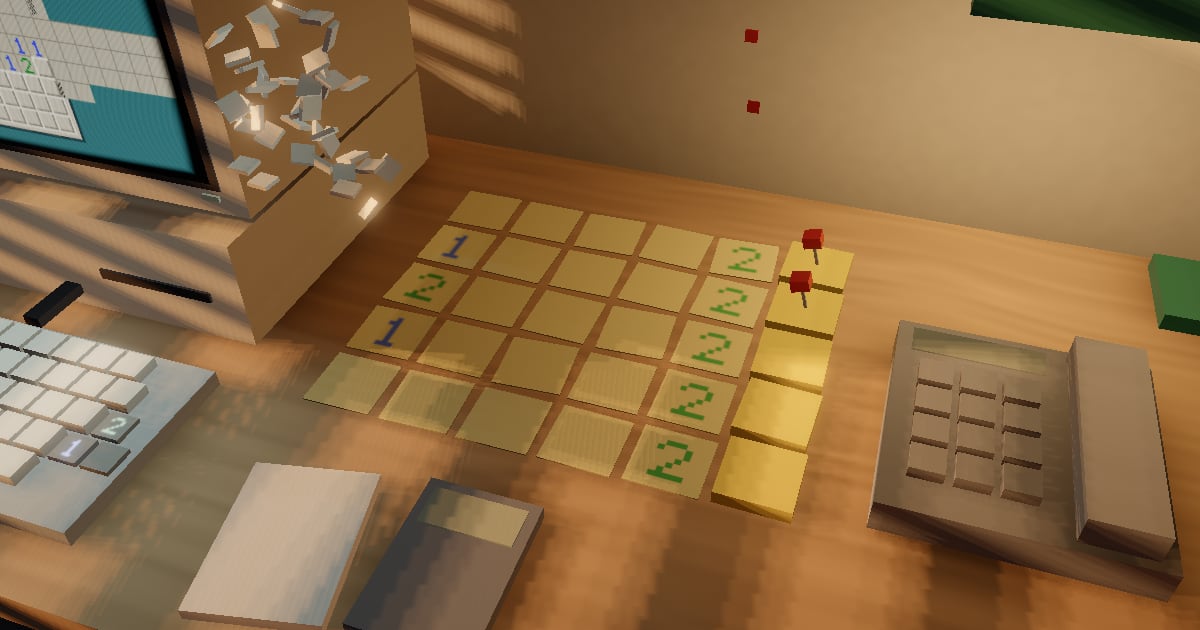
The first click is always safe, and it always floods. The flood reaches the edge of the game’s frame and keeps going, across the wallpaper to the edge of the glass. Then the camera pulls back. You are in an office at the end of the day, and the tiles are landing on the desk.
From there the whole room is one board.
- Sticky notes are cells. So are the keys on the keyboard, the buttons on the phone and a sheet of bubble wrap.
- Up the wall, the days on the calendar and the slots in the post rack join in. Then the ceiling and carpet tiles.
- A number counts its neighbours across the join. A sticky note at the edge of the pad counts the key beside it.
- Point at a cell and every cell it touches gets a blue box, on any surface. I asked for that after a test play.
- Hopping 3D arrows and the arrow keys take you round.
- Flags are drawing pins. A mine is a cloud of printer toner, and it only resets the surface you were on.
Fair, but not easy
I asked for a difficulty that is fair but real. A solver checks every board before you see it. If logic alone cannot clear the board, mines move until it can, so you never have to guess. Most boards still need you to compare two numbers.
Bots hold that promise in the tests. A solver bot clears 200 boards in a row without one guess. A bot that clicks at random hits 46 mines for every surface it clears.
The light
The room had to look like a film still. The trick is to do the costly light once. While you look at the flat grey desktop, the page is path tracing the office behind it, a strip at a time, and storing the bounced light in a texture. A wavelet filter cleans up the result. Small things and moving things take their light from a grid of probes baked in the same pass.
Sunlight through the blinds is drawn live, through a shadow map, so the stripes stay sharp. Each lamp is baked on its own layer. That lets the sun set and the ceiling tubes flicker on while you play. Bloom, depth of field and a film tone curve finish the frame.
It’s one HTML file of about 150 KB. There are no libraries, no images and no audio files.
Claude built it in a single session on 15 November 2026, running Anthropic’s Fable 5.2 model, while I directed.
It’s the fifth of the Fable 5.2 One-shots: small browser pieces, each pushed as far as it will go in one session.